Grip or Slip: How Smart Tire Choices and Track Temp Reads Decide Who's Standing in the Winner's Circle
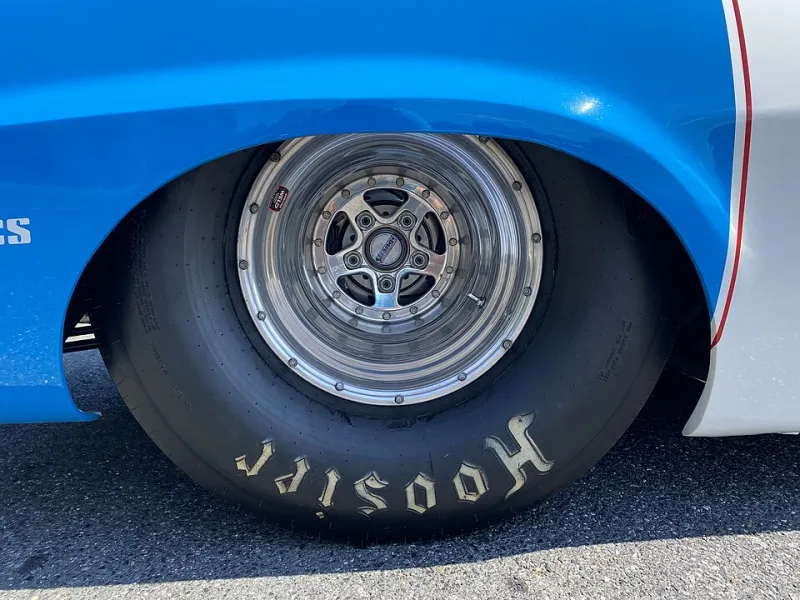
Photo: CZmarlin — Christopher Ziemnowicz, a photo credit would be appreciated if this image is used anywhere other than Wikipedia., CC BY-SA 4.0, via Wikimedia Commons
You can have the meanest motor on the property, a flawless chassis setup, and a driver with ice in their veins — and still lose the race before the tree even blinks green. The reason? Tires. More specifically, the wrong tire compound meeting the wrong track surface at the wrong temperature. In front-engine dragster racing, where weight transfer happens fast and violent, getting your rubber dialed in isn't a bonus step. It's the whole game.
Veteran crew chiefs will tell you the same thing: the tire decision is made before the burnout even starts, and it's made with real information — not gut feelings.
Why Compound Matters More Than Most Racers Admit
Tire compound refers to the chemical makeup of the rubber itself — how hard or soft it is, how it reacts to heat, and how aggressively it grips a prepared surface. Drag racing slicks aren't all the same. Different manufacturers offer multiple compound ratings, and choosing between them isn't a casual call.
A softer compound generates grip faster and at lower surface temperatures, which sounds like a universal win — until the track gets hot and greasy mid-afternoon, and that same soft tire starts spinning like it's sitting on ice. A harder compound takes longer to come up to operating temperature but holds its grip window longer and handles heat-soaked track conditions more predictably.
For front-engine dragsters specifically, the challenge is compounded (no pun intended) by the weight bias toward the front of the car. That means the rear tires are working hard from the jump to hook up under a chassis that isn't naturally inclined to plant them. Pick the wrong compound, and all the chassis tuning in the world won't save your sixty-foot time.
Reading the Track Like a Veteran
Seasoned crew chiefs don't just glance at the sky and make a call. They're gathering data constantly. A non-contact infrared pyrometer is standard equipment in any serious pit setup, and the smart ones are shooting the track surface temperature at multiple points — the starting line, the shutdown area, and sometimes mid-track — throughout the day.
Why multiple points? Because track temperature isn't uniform. The burnout box takes a beating from heat and rubber buildup. The starting line itself can be several degrees different from the surface twenty feet ahead, especially on a west-facing strip in the late afternoon sun. Those differences matter when you're trying to predict how a compound will behave through the first sixty feet.
Track temperature windows vary by compound, but as a general rule, most drag racing slick compounds are working optimally somewhere between 90°F and 130°F surface temperature. Below that, you're likely under-gripping. Above it, you're risking a greasy, unpredictable launch. The goal is to put your tire in the middle of its happy zone right when the tree drops.
The Burnout Is a Tool, Not a Show
Here's something a lot of newer racers misunderstand: the burnout isn't just about looking cool or cleaning the tire. It's a deliberate thermal management step. The length and aggression of your burnout directly influences how much heat you're putting into the compound before you stage.
On a cool morning with a cold track, a longer, harder burnout helps bring a tire up to working temperature. On a hot afternoon when the track is already well-prepped and sticky, a shorter, more controlled burnout prevents overheating a compound that's already close to its upper limit.
Front-engine dragster crews have to be especially precise here because the weight distribution means you're not getting the same kind of natural rear-tire loading you'd see in a rear-engine car. The tire needs to be ready before the car loads it — not after.
Atmospheric Conditions Change the Equation
Track temperature doesn't exist in a vacuum. Humidity, ambient air temperature, and even barometric pressure all influence how a surface behaves and how a tire responds to it. A surface reading of 110°F on a dry, low-humidity day behaves differently than the same reading on a muggy August afternoon in the Southeast.
High humidity tends to reduce track grip somewhat, even when the surface temp looks right. That's because moisture in the air affects the rubber's interaction with the track prep chemicals. Experienced crew chiefs factor this in by sometimes going to a slightly softer compound when humidity spikes, compensating for the reduced surface bite.
This is where keeping a detailed log becomes invaluable. If you're racing the same track across multiple seasons, your own data — compound selection, burnout length, track temp, humidity, and ET — becomes a tuning reference that no generic recommendation can match.
Practical Compound Selection Framework
So how do you actually decide? Here's a simplified framework that mirrors what experienced front-engine dragster crews use as a starting point:
Cool conditions (track surface below 90°F): Lean toward a softer compound. Extend your burnout to build tire heat. Watch for any tendency to spin at launch and be ready to adjust tire pressure down slightly to increase contact patch size.
Optimal conditions (90°F–130°F surface temp): This is your target window. A medium compound typically performs well here. Standard burnout protocol. This is where your baseline setup should be dialed in.
Hot conditions (above 130°F surface temp): Consider a harder compound. Shorten the burnout to avoid overheating. Watch for tire shake on the hit, which can indicate a tire that's been pushed past its thermal limit.
Tire pressure is the real-time adjustment tool that works in combination with compound selection. Dropping pressure increases the contact patch and can help a harder tire find grip in marginal conditions. But go too low and you risk excessive tire growth at launch, which throws off your chassis geometry and can introduce unpredictability.
The Marginal Gains Add Up
Elite front-engine dragster pilots and their crew chiefs aren't necessarily doing something radically different from everyone else. They're doing a lot of small things more consistently and more precisely. Tire strategy is one of the clearest examples of that principle in action.
A tenth of a second in your sixty-foot time can be the difference between a round win and an early exit. And a big chunk of that tenth lives in the tire compound decision, the burnout execution, and the real-time track temperature read that informed both of those choices.
Get in the habit of treating every run as a data collection opportunity. Shoot the track, log your conditions, note your compound, and record your results. Over time, that information becomes your competitive edge — built upfront, like everything else on a front-engine dragster.