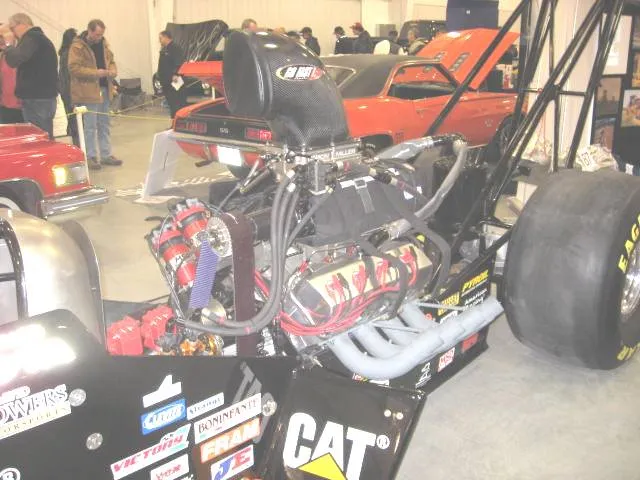
Feed the Beast Right: Picking the Perfect Fuel System for Your Front-Engine Dragster
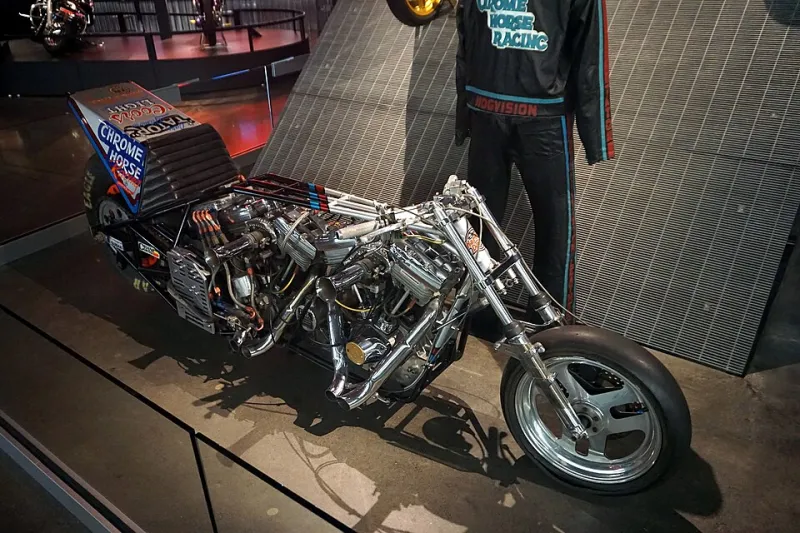
Photo: Michael Barera, CC BY-SA 4.0, via Wikimedia Commons
Here's a truth every front-engine dragster builder eventually runs into: you can have the baddest engine on the property, but if it's not getting fed right, you're leaving time on the table. Fuel delivery is one of those topics that gets glossed over in favor of cubic inches and cam specs, but the guys who consistently win — week in, week out — have figured out that the fuel system isn't a footnote. It's the whole story.
So let's get into it. Carburetors, electronic fuel injection, and nitrous oxide each bring something different to the front-engine platform. Which one belongs under your hood depends on your class, your budget, and honestly, how much tuning you're willing to live with.
The Old Guard: Why Carburetors Still Win Races
There's a reason the carburetor has survived every technological wave that's swept through drag racing. It's simple, it's proven, and when it's dialed in, it flat-out works.
For bracket racers and sportsman-class competitors running naturally aspirated small-blocks or big-blocks, a properly tuned Holley double-pumper or a Demon carb remains one of the most cost-effective paths to consistent performance. We're talking initial hardware costs in the $400–$900 range for a quality unit, with tuning that any experienced engine builder can handle with a timing light and a set of jets.
Take the case of Dale Hutchins out of Mooresville, North Carolina. Dale's been running a '70s-era front-engine slingshot with a built 454 BBC for going on six years. He's running a 750 cfm Holley with a custom-ground cam, and his consistency in the Super Gas class has earned him back-to-back regional championships. "I can tune that carb in the pits in twenty minutes," Dale told us. "I know exactly how it responds to temperature and humidity. I'm not chasing a laptop — I'm chasing a dial-in."
The downside? Carburetors don't love altitude changes, they can be sensitive to fuel pressure fluctuations, and they require hands-on attention every time conditions shift. If you're running a one-track local program, that's manageable. If you're traveling the national circuit across different climates, you'll be earning every tenth you run.
Best for: Bracket racing, sportsman classes, budget-conscious builds, racers who prefer mechanical simplicity.
The Modern Edge: Electronic Fuel Injection and What It Actually Buys You
EFI has gone from exotic to accessible in the last decade, and the front-engine drag racing community has taken notice. Systems from FAST, Holley Sniper, and MSD now make it possible to bolt on a self-learning throttle body injection setup for under $1,500 — a number that would've seemed impossible fifteen years ago.
The core advantage of EFI isn't peak power. A well-tuned carburetor can match a fuel-injected engine's peak numbers on the dyno. The real win is consistency. EFI systems constantly monitor oxygen sensors, coolant temp, and manifold pressure, making micro-adjustments on every pass that a carburetor simply can't replicate. In heads-up racing where you're chasing hundredths, that consistency matters enormously.
Ricky Salazar runs a front-engine dragster out of the Dallas-Fort Worth area in a local heads-up bracket that's become increasingly competitive. After years on a four-barrel carb, he made the switch to a Holley Sniper EFI system two seasons ago. "The first weekend I ran it, I went three rounds deeper than I had all year," Ricky said. "The car just hit the same number over and over. Hot laps, cold laps — it didn't matter."
That said, EFI comes with a learning curve. You need to understand fuel maps, sensor diagnostics, and laptop-based tuning. If something goes sideways in the staging lanes, it's not a quick jet swap. You're plugging in a laptop and reading data. For racers who are comfortable in that world, it's a serious competitive tool. For guys who want to stay away from screens, it can be a source of frustration.
Higher-end systems — think Haltech or MoTeC with full sequential injection — push costs into the $3,000–$8,000 range but offer data logging and tuning precision that borders on professional motorsport territory.
Best for: Heads-up racing, multi-climate travel schedules, racers comfortable with data-driven tuning, moderate to higher budgets.
The Wild Card: Nitrous Oxide and the Art of Controlled Explosions
Nitrous is the great equalizer. Done right, it turns a modest engine program into a weapon. Done wrong, it turns your engine into expensive scrap metal.
In front-engine drag racing, nitrous is most commonly used in two ways: as a standalone power adder on a naturally aspirated combination, or as a supplement to an already-built engine looking to step up to another class. A basic wet plate system from Nitrous Express or Zex can be had for $500–$900 and will deliver anywhere from 75 to 150 horsepower in additional output when activated. Progressive controllers let you dial in how quickly the shot comes on, which is critical in a front-engine car where violent power spikes can spin the tires off the launch.
Mike Fenton, a veteran front-engine builder from Ohio, has been running nitrous combinations for over a decade. He's currently campaigning a 540 cubic inch big-block with a 150-shot of nitrous, running consistent 7.80s in a local outlaw class. "Nitrous is cheap horsepower when it's working," Mike explained. "But you've got to stay on top of your bottle pressure, your fuel system has to be bulletproof, and you need to know when to say no to a bigger jet."
That's the real discipline with nitrous — restraint. The temptation to go bigger is always there, and the engine doesn't always survive the experiment. Proper fuel system support (upgraded injectors or main jets, a dedicated fuel pump, and a reliable pressure regulator) is non-negotiable. Lean nitrous kills engines fast.
For budget racers looking to compete above their natural engine class without a full rebuild, nitrous offers a compelling shortcut. But it demands respect.
Best for: Budget power upgrades, outlaw and bracket classes, racers willing to maintain a meticulous system and stay disciplined with jetting.
Matching the System to the Mission
At the end of the day, the right fuel system is the one that fits your class rules, your budget, and your willingness to tune. Here's a quick cheat sheet:
- Tight budget, local bracket program? A well-tuned carburetor is still a completely legitimate path to a win light.
- Competitive heads-up racing with travel? EFI's consistency will pay dividends over a full season.
- Looking to jump a class without rebuilding the engine? A properly set up nitrous system might be the most cost-effective move you can make.
There's no universal answer here, and anyone who tells you otherwise is trying to sell you something. Talk to the guys running your class, understand your track's conditions, and build a fuel system that fits the program — not someone else's highlight reel.
Because at the end of the day, it's not the most exotic setup that wins. It's the one that hits the same number every single pass.