More Chassis, Less Ego: The Real Secret Behind Consistent Front-Engine Dragster Wins
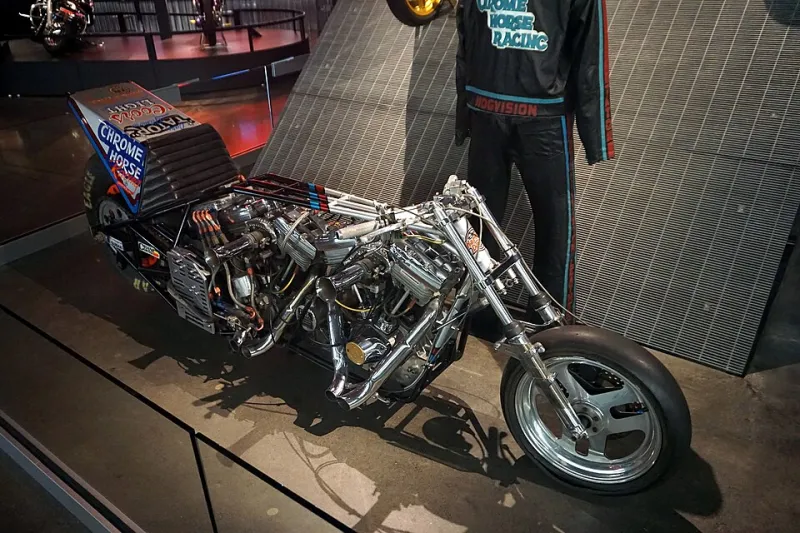
Photo: Trekphiler, CC BY-SA 3.0, via Wikimedia Commons
Let's be honest about something. Walk through any pit area at a regional drag meet and you'll hear the same conversation happening in a dozen different spots. Cubic inches. Compression ratios. Cam duration. Horsepower claims that get bigger every time someone retells the story. Power is the currency of drag racing culture, and nobody wants to admit they're running light.
But here's what you won't hear nearly as often: talk about pinion angle. Anti-squat geometry. Weight distribution percentages. Shock valving. The stuff that actually determines whether all that horsepower gets transferred to the track — or just smokes the tires and embarrasses you off the line.
I'll say it plainly: in front-engine drag racing, chassis setup is more important than peak horsepower. Not equally important. More important. And the racers who've figured that out are the ones who keep winning.
Why the Launch Tells the Whole Story
A front-engine dragster is a fundamentally different animal than a rear-engine car. The weight distribution — with the engine sitting out front — creates a unique dynamic at launch. When you hit the throttle, the car wants to transfer weight rearward, which loads the rear tires and can actually work in your favor. But if the chassis geometry isn't set up to manage that transfer in a controlled, predictable way, you're not getting a launch — you're getting chaos.
The first sixty feet of a drag race often decide the entire run. Veteran racers know this. A car that hooks cleanly and loads the tires progressively will beat a car with 100 more horsepower that bogs, spins, or porpoises down the track almost every time. The elapsed time clock doesn't care how much you spent on your heads.
This is where anti-squat geometry becomes one of the most powerful tuning tools in your arsenal. Anti-squat — the tendency of a chassis to resist compression under acceleration — directly affects how quickly and smoothly weight transfers to the rear tires at launch. Too little and the car squats violently, unloading the front suspension and making the car unpredictable. Too much and the tires get overloaded instantly, causing spin. Getting it dialed in for your specific combination of weight, power, and tire is a process that takes time and track data, but the payoff is enormous.
Talking to the Guys Who Actually Get It
We caught up with Tommy Briggs, a front-engine dragster racer out of central Tennessee who's been competing in bracket classes for eleven years. Tommy's running a 355 cubic inch small-block — nothing exotic — but he's been one of the most consistent performers in his region for the last three seasons.
"People see my car and they figure I'm not running much power," Tommy said with a grin. "And they're right. But I've spent more time on my four-link geometry than most guys spend on their entire build. I know exactly how that car is going to leave every single time. When your opponent is chasing a tire spin and you're already sixty feet ahead, the horsepower argument kind of goes away."
Tommy works closely with chassis tuner Greg Allard, who has built and set up front-engine cars for over two decades across the Southeast. Greg's perspective is blunt: "Most amateur racers buy horsepower because it's easy to understand. You bolt on a bigger cam or more compression and the dyno number goes up. Chassis tuning is harder to quantify, so people ignore it. But I've seen 800-horsepower cars get beat by 500-horsepower cars all day long because the fast car was just better underneath."
Greg's process with a new build starts with corner weighting and establishing the baseline weight distribution before the engine ever fires. "You'd be amazed how many cars come to me with 60 percent of the weight on the wrong end," he said. "We fix that before we ever talk about shock valving or ride height."
Suspension Tuning: The Details Nobody Posts on Social Media
Shock absorbers in a drag racing application aren't about ride comfort — they're about controlling the rate of weight transfer. A shock that's too stiff on compression will prevent the rear suspension from loading properly, causing tire spin. Too soft and the car will wallow and lose stability mid-track.
For front-engine dragsters specifically, the front suspension setup plays a bigger role than many builders realize. Because the engine mass is sitting forward of the front axle centerline, managing front suspension travel during launch directly affects how the car tracks through the first hundred feet. Cars that nose-dive under acceleration are losing control of their weight distribution at the worst possible moment.
Linkage geometry — particularly the relationship between the four-link bars and the pinion angle — determines how the rear axle behaves under torque load. A pinion angle that's too steep can cause wheel hop. Too flat and you lose the mechanical advantage that keeps the tires loaded. These aren't set-and-forget adjustments. They change with tire compound, track prep, temperature, and power level.
Sarah Kowalski, who campaigns a period-correct front-engine slingshot out of the Chicago area, has become something of a local legend for her ability to tune her car on-site between rounds. "I carry a notebook to every race," she told us. "Launch RPM, weather conditions, how the car felt at sixty feet. After a few seasons you start seeing patterns. The car tells you what it needs if you're paying attention."
Sarah's car runs a modest 400 horsepower combination. She regularly outruns cars making significantly more power. "Horsepower is easy," she said. "Making the car do what you want it to do — that takes work."
The Mindset Shift That Changes Everything
Here's the thing about chassis tuning that makes it a hard sell to some racers: the improvements aren't always dramatic in the way a new cam or a bigger carburetor feels dramatic. A properly set up chassis just makes the car feel... right. Predictable. Stable. Boring, in the best possible way.
And boring is fast.
The racers who dominate their classes over multiple seasons aren't the ones who show up with the most horsepower every weekend. They're the ones whose cars leave on the same spot every time, load the tires the same way every time, and give the driver a consistent, repeatable platform to work from. That consistency is built into the chassis, not the engine.
If you're serious about improving your program, the next dollar you spend probably shouldn't go toward more power. It should go toward a good chassis guy, a set of scales, and the patience to work through your suspension setup systematically.
Because at the end of the day, the car that hooks cleanly wins the race. Every time. And that starts a lot lower than the carburetor.