Five Grand vs. Fifty: What Two Very Different Front-Engine Dragster Budgets Actually Buy You at the Strip
Let's kill the myth right up front: you don't need to spend fifty thousand dollars to go fast. But you do need to spend your money smart. The difference between a shoestring front-engine dragster build and a fully funded race machine isn't always as dramatic as the price tags suggest — and in some cases, the guy running on fumes and ingenuity is pulling ETs that would embarrass a few guys who bought their way to the line.
We broke down two real-world build scenarios, talked to racers on both ends of the spectrum, and tried to figure out exactly where the dollars make a genuine difference and where they're just buying bragging rights.
What $5,000 Actually Looks Like
Five thousand dollars in the front-engine dragster world means you're hunting. You're combing Facebook Marketplace at midnight, haunting swap meets, and calling in favors from guys who've been in the game longer than you've been driving. It's not glamorous, but it works.
A typical build at this budget usually starts with a used chassis — often something that's been raced hard and retired, picked up for $800 to $1,500 depending on condition and pedigree. Inspect it thoroughly, because a cracked tube or a bent frame rail will cost you more to fix than you saved buying cheap. If the chassis is solid, that's your best win at this price point.
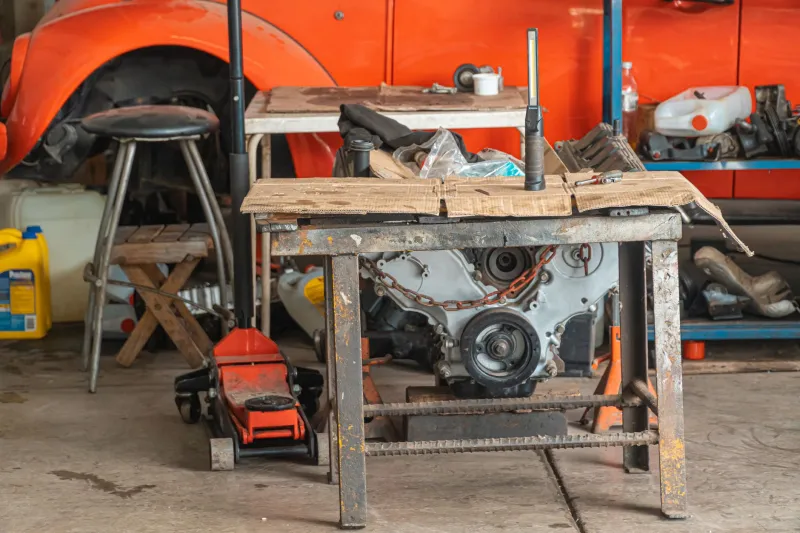
Engine-wise, you're looking at a used small-block Chevy or Ford — something in the 350 to 400 cubic inch range that's been rebuilt at least once. Budget around $1,200 to $1,800 for something that runs reliably. You're not making 700 horsepower, but a healthy 400-horse motor with a decent tune can still move a lightweight dragster down the track in a hurry.
The rest of the budget covers a basic carb setup, a used transmission, tires that aren't brand new but aren't cracked either, and whatever safety gear you can squeeze in. Helmet, suit, and a fire system aren't optional — they're where you should never cut corners, even if it means borrowing money or waiting an extra month to race.
What you end up with is a machine that's honest, a little rough around the edges, and surprisingly competitive in bracket classes where consistency matters more than raw power.
What $50,000 Gets You
Fifty thousand dollars changes the conversation entirely — but maybe not in the ways you'd expect. Yes, you can buy a purpose-built chassis from a reputable fabricator. Yes, you can run a fresh, blueprinted big-block with forged internals, a roller cam, and a professional dyno tune. Yes, your tires are new Hoosiers, your fuel system is dialed in, and your data logger is logging.
But here's what that money is really buying: consistency and confidence. The $50,000 build doesn't have to wonder if that used carb is going to act up on a cold morning. It doesn't have to guess whether the clutch is slipping because of wear or because the setup is wrong. Every variable has been addressed, documented, and tested.
A quality chromoly chassis alone can run $8,000 to $15,000 from a respected builder. A fresh big-block — bored, stroked, and assembled with quality parts — can easily land between $10,000 and $18,000 once you factor in machining, assembly, and a dyno session. Add a quality transmission, a proper clutch setup, a fuel cell, and all the ancillary systems, and you're looking at a build where every component was chosen intentionally.
The data acquisition system — something the $5,000 builder almost certainly doesn't have — is arguably one of the biggest performance advantages at this level. Knowing exactly what your car is doing at every point in the run gives you the ability to tune with precision instead of guessing.
Where the Budget Builder Punches Above His Weight
Here's what the numbers don't tell you: driver skill and setup knowledge close the gap more than most people want to admit. Bracket racing, in particular, rewards consistency and reaction time over outright speed. A driver who knows his car's habits, who can dial in a number and hit it repeatedly, will beat a better-funded competitor who's still learning his machine every single weekend.
The $5,000 build also forces a kind of mechanical intimacy that money can't buy. When you've wrenched every bolt yourself, when you've learned the car through necessity rather than convenience, you develop an intuition for what it's doing and why. That knowledge translates directly into better decisions at the line and faster diagnoses when something goes wrong.
Used parts, when sourced carefully, also perform surprisingly well. A carb that's been professionally rebuilt is functionally identical to a new one. A chassis that's been properly inspected and repaired is structurally sound. Not every dollar of depreciation represents lost performance.
Where the Money Genuinely Matters
That said, there are places where spending more isn't just about ego — it's about real-world performance and safety.
Chassis quality is the big one. A well-built chromoly chassis from a reputable fabricator isn't just stiffer and lighter than a bargain-bin alternative — it's safer. When something goes wrong at speed, you want metal around you that was designed and built by someone who knew what they were doing.
Tire quality and consistency is another area where the investment pays off. Running matched, properly prepared Hoosiers versus used rubber with unknown history is a genuine ET difference, not just a comfort thing.
Fuel system reliability separates racers from spectators at the worst possible moments. A lean condition at full throttle because your fuel delivery couldn't keep up isn't just slow — it's engine-destroying. This is one area where the $5,000 builder should prioritize even if it means skimping somewhere else.
Safety equipment deserves its own category entirely. Helmet, suit, fire suppression, and a properly certified roll structure aren't performance items — they're the reason you get to race again next weekend.
The Honest Verdict
If you've got $5,000 and a willingness to learn, you can absolutely build a front-engine dragster that competes. You'll win some, you'll lose some, and you'll learn more about going fast in a single season than most people learn in five years of watching from the stands.
If you've got $50,000, you can build a machine that removes variables, rewards precision, and gives you every tool you need to be genuinely fast. But you still have to drive it.
The strip doesn't care what you spent. It only cares what you do with it. And in this sport, that's the most honest truth there is.